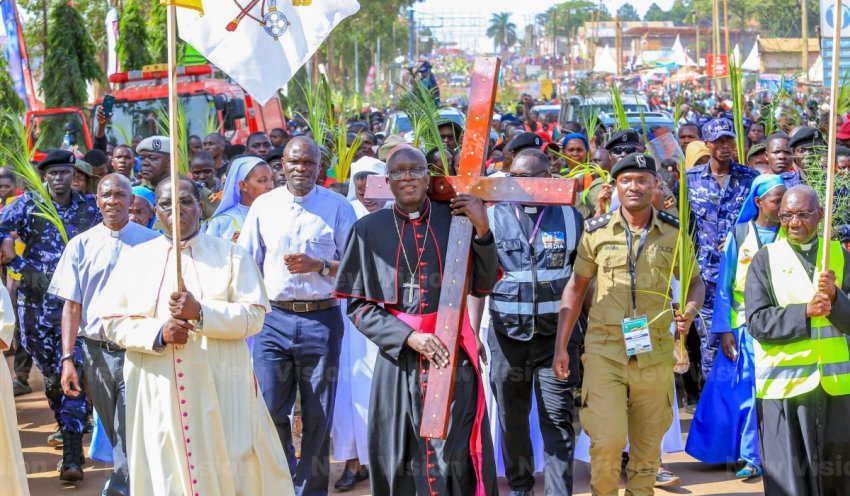
Hundreds of Rwandan pilgrims have joined this year’s Uganda Martyrs Day celebrations in Namugongo, Kampala — one of Africa’s largest and most spiritually significant Christian events. Among them are eight Catholic bishops and Cardinal Antoine Kambanda, Rwanda’s only cardinal.
The annual celebration, held every June 3, honours the memory of 45 Ugandan martyrs — 22 Catholics and 23 Anglicans — who were executed between 1885 and 1887 for refusing to renounce their faith. These martyrs were killed on the orders of Kabaka Mwanga II of Buganda, and their sacrifice continues to inspire millions across the region.
Father Vedaste Kayisabe, Secretary General of the Council of Catholic Bishops in Rwanda, confirmed that over 200 Rwandan pilgrims made the journey this year. Most of the faithful came from the Archdiocese of Kigali, as well as the dioceses of Nyundo, Ruhengeri, and Kibungo.
“We are here in large numbers,” Fr. Kayisabe said. “Eight bishops from Rwanda have joined us, and the spiritual atmosphere is powerful.”
On June 2, Cardinal Kambanda led a special mass at the Basilica Minor of Munyonyo, a historic site where Saint Andrew Kaggwa — one of the Uganda Martyrs — was executed. Many pilgrims had already arrived by then, having traveled days earlier by bus or plane to take part in the full spiritual journey.
Some Rwandan pilgrims have been camping at the Namugongo shrine for more than a week, embracing the experience of prayer, reflection, and sacrifice. In Uganda, June 3 is a public holiday, and it’s common for thousands to make the pilgrimage on foot, gathering days in advance.
The Rwandan delegation’s trip was coordinated in part by Christians from Saint Charles Lwanga Parish in Nyamirambo, Kigali — a church named after one of the Uganda Martyrs. Each pilgrim covered their own costs for transport, food, and lodging, with expenses averaging around $100.
According to Fr. Kayisabe, the pilgrimage holds deep meaning for Rwandan Catholics, who feel spiritually linked to Namugongo and its history.
“There is a shared heritage,” he explained. “The same missionaries — the White Fathers — who brought the faith to Uganda also came to Rwanda. Bishop John Joseph Hirth, for example, served in both Uganda and Tanzania before becoming the first bishop of Kabgayi. His remains are buried there to this day.”
For many pilgrims, visiting Namugongo is a moment of renewal. They reflect on the unwavering faith of the martyrs — many of whom were young men — and draw inspiration from their courage.
“The martyrs’ testimony challenges us. It shows that standing firm in faith is possible,” Fr. Kayisabe said. “This is why Rwandans continue to come here. It strengthens their spirit.”
Namugongo’s Catholic Shrine — where most of the martyrs were killed — remains the heart of the commemorations. The journey often begins at Munyonyo, where several of the martyrs were first imprisoned, and ends with the grand celebration at the shrine on June 3.
Src: The New Times